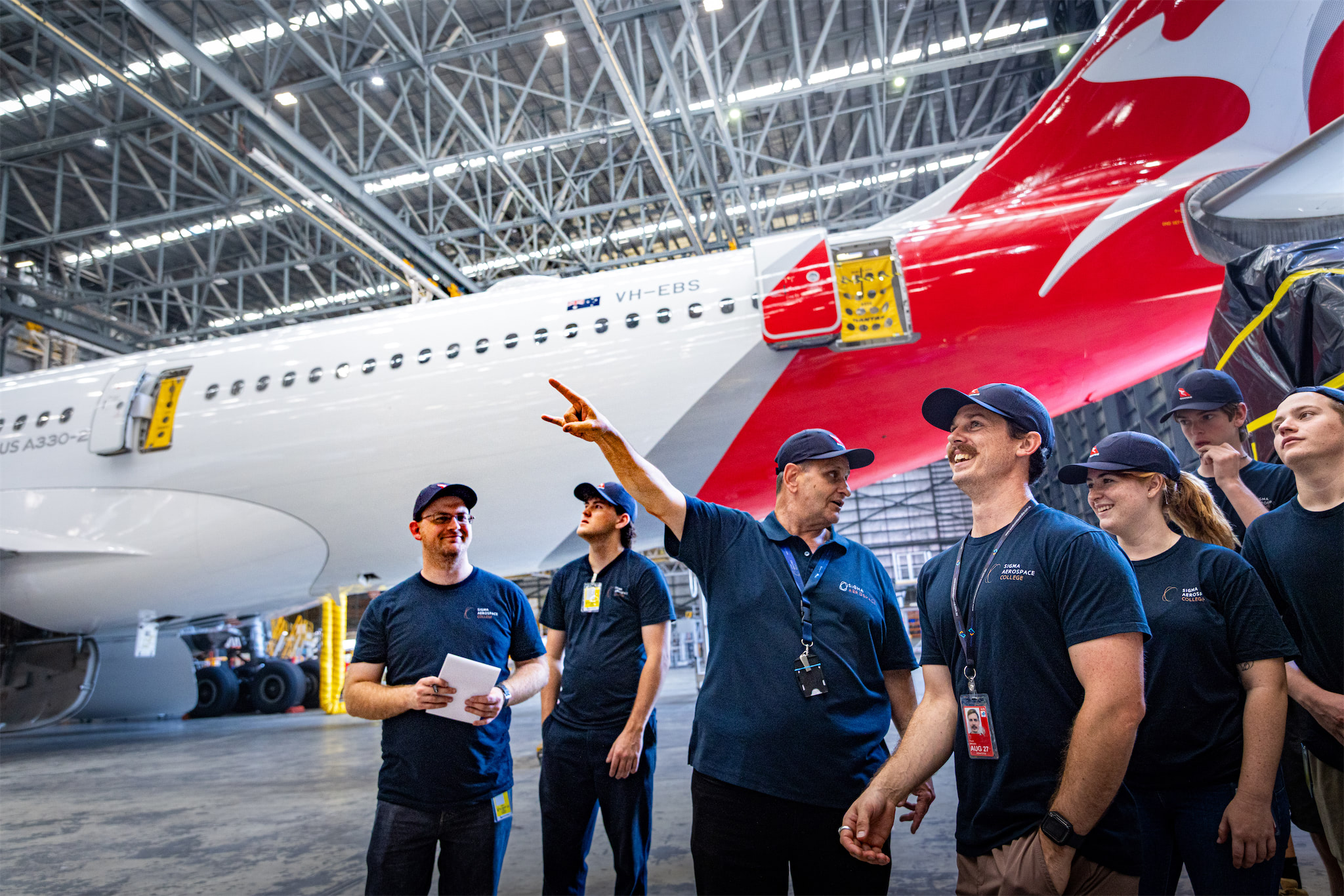
To become an aircraft mechanic in Australia, the usual starting point is a job with an aircraft maintenance employer and an Aeroskills apprenticeship. You learn at work, complete the required training and earn a trade qualification. A CASA licence is a further, separate outcome.
In Australia, the role is usually called an Aircraft Maintenance Engineer (AME). “Aircraft mechanic” is a common search term for the same kind of hands-on maintenance work. An AME maintains aircraft or components within their role and supervision arrangements. A Licensed Aircraft Maintenance Engineer (LAME) holds a CASA licence with defined certification privileges. A qualification alone does not make you a LAME.
This guide is about maintaining aircraft, not designing them. If you are comparing maintenance with university engineering, read aircraft maintenance versus aeronautical engineering.
Start with the route that fits you
Find an employer. Start an apprenticeship.
School leavers and adult career changers need a suitable maintenance job before workplace enrolment. Join the apprentice candidate database and read our school-leaver guide. Joining the database does not guarantee a job.
Agree a training plan with your employer.
If you work in a suitable maintenance role, ask your employer about an apprenticeship or traineeship. An Apprentice Connect Australia Provider helps establish the training contract and nominate Sigma as the training provider.
Use the credit you have earned.
Engineers with relevant experience may suit RPL and gap training. We assess existing units, exams and practical evidence against the outcome, then train and assess the gaps. Check the course’s experience and current-work requirements.
Map your experience to the Australian outcome.
You may already hold useful training and evidence. Read the Defence pathway or overseas licence conversion guidance before choosing a course.
How to become an aircraft mechanic: five practical steps
1. Choose the work you want to do
Mechanical engineers work on aircraft mechanical systems and engines. Avionics engineers work on electrical, instrument and electronic systems. Structures work focuses on the aircraft’s structure and its repair. Your employer’s aircraft, approvals and available tasks affect the training you can complete.
Aircraft maintenance and component maintenance are also different work settings. A component workshop can offer a strong trade career, but its tasks do not automatically provide all the experience needed for an aircraft licence. Compare the career streams before choosing a qualification.
2. Look for a real maintenance job
Apply to airlines, general aviation operators, maintenance organisations and component workshops. Read each vacancy carefully: employers set their own education, work-rights and selection requirements. Maths, English, practical problem-solving and evidence of an interest in mechanical or electrical work can help you prepare.
Keep checking Sigma’s aircraft engineer jobs board and employers’ own apprenticeship vacancies. A trade assistant role can give you exposure to a workshop, but it is not automatically an apprenticeship or a licence pathway.
3. Set up the apprenticeship properly
Once an employer is ready to take you on, contact an Apprentice Connect Australia Provider (ACAP). They help arrange the training contract, check the appropriate qualification and nominate the training provider. The contract is a formal agreement between the employer and apprentice; it identifies the qualification and training arrangements. See the NSW training-contract explanation and the requirements for your own state or territory.
To train with Sigma, ask the ACAP to nominate Sigma as the training provider. Once we receive the notification, we start enrolment and agree the training plan with you and your employer. Read the enrolment steps. Already an apprentice elsewhere? You can discuss transferring to Sigma.
4. Build skills and complete the qualification
With Sigma’s workplace apprenticeship model, practical learning takes place at work under a suitable supervisor. Theory and knowledge assessments are completed online, with trainer support and planned workplace visits. There is no recurring block-release requirement.
The Certificate IV in Aeroskills is a trade qualification made up of units of competency. You must demonstrate the required knowledge and practical skills. Units, qualifications and CASA exams each serve a different purpose.
5. Plan a CASA licence if your career needs one
A licence can be a later step, or your employer can agree to include licence training and exams alongside the apprenticeship. CASA provides Part 147 MTO and self-study pathways, with different training arrangements. Both require the applicable knowledge examinations and practical experience. The Part 147 pathway also requires the applicable competency-based training and assessment. CASA explains the licensing pathways.
Do not choose a diploma simply because you have been told “you need a diploma for a licence”. The licence outcome depends on the specified units, exams and experience—not the qualification title alone. We map the training to the intended outcome and recognise eligible credit. See how the Certificate IV, Diploma and licence fit together.
How long does it take, and what does it cost?
Plan for a substantial period of supervised work and study. Completion depends on the training contract, competence, prior credit and access to the required tasks. A licensing pathway adds its own experience and assessment requirements. See Sigma’s indicative workplace training durations.
Training fees depend on the agreed outcome, credit and any applicable funding. Employer incentives and subsidised course fees are separate matters; your ACAP can help check the employer’s position. For Sigma, compare the fee-for-service packages and quarterly support fee with the Queensland funding and co-contribution schedule.
A beginner needs training. An experienced engineer may need gap training.
RPL is not a shortcut for someone who has not done the work. It recognises competence you can demonstrate. Sigma’s RPL and gap training packages lead to an agreed outcome; we do not sell standalone RPL reports.
Common questions before you start
Do I need a pre-apprenticeship course?
Not in every case. Employers have different entry requirements. A preparatory course may help, but it does not replace the workplace training or guarantee employment. Read our pre-apprenticeship FAQ.
Can I start as an adult?
Yes, an adult can pursue an aircraft maintenance apprenticeship. You still need an employer, a suitable role and the required training arrangements. Discuss pay, contract conditions and eligibility with the employer and ACAP before committing.
Can I enrol with Sigma before I have a job?
Our workplace delivery needs suitable employment, supervision and task access. Experienced-engineer courses also have current-work and experience requirements. If you are seeking your first role, start with the candidate database, not a paid RPL application.