The best people in
aircraft maintenance

Qantas aircraft parked at airport gates

Aircraft maintenance apprenticeships & traineeships

Apprentice training.Built around your operation.

We train apprentices for the qualification and aircraft maintenance role agreed with you and your apprentice. Where a CASA licence is the goal, we plan the relevant units, exam preparation and CASA exams together.

Choose a qualification-only pathway or an integrated licence pathway. We agree the scope, fees and exam timing before training starts.

Apprenticeships · Start in the right place

A first role.
A training place. A stronger team.

Choose the option that describes you. Each has a different next step.

01 / Looking for work

I need an apprenticeship or TA role.

Build your resume and candidate profile so aircraft maintenance employers can learn about you. You can start with school, practical projects and other work experience.

Build my resume & joinJoining the database is not a course application or a job offer.
02 / Already have an employer

I need to arrange my training.

Tell us who employs you, your workplace location and the trade you are entering. We will work with you and your employer on the training arrangements.

Arrange apprentice trainingHave your employer contact and any previous training results ready.
Changing training provider?

Bring the records. We will help plan the handover.

Have your employer and workplace details, current qualification and provider, completed unit results, training plan and Apprentice Connect contact ready. We will check the remaining training and funding arrangements with you.

Engineer working on an aircraft access panel

Learn It.
Use It On The Job.

Understand why the task matters.

A long classroom block can feel remote from the job waiting back in the hangar. Our workplace model connects manageable learning sections with supervised maintenance tasks and feedback from a trainer.

You still need protected study time. Your employer supplies suitable work, qualified supervision and access to current maintenance data. We help you and your supervisor understand what evidence is needed, check progress and deal with gaps.

That means less guesswork about what to do next, and a clear reason for the study you are doing.

How we train. How we assess.

Yes, we provide CASA exams.
We prepare students before they sit them.

For each subject, students first complete the relevant MEA knowledge assessments. These address all required knowledge for the units. We assess practical competence through the required workplace evidence and assessment.

  1. 01

    Learn

    Work through structured resources in manageable sections.

  2. 02

    Practise

    Apply the learning to supervised maintenance tasks.

  3. 03

    Review

    Ask questions, get feedback and address gaps.

  4. 04

    Demonstrate

    Show the knowledge and practical evidence required by the whole unit.

A real unit. A simplified illustration.

MEA107 · Maintenance manuals & specifications

CASA exam used as the only knowledge assessment

A pass in the paper. What about the unit?

If knowledge is assessed only through a CASA exam, the result covers the questions asked. It does not separately establish every knowledge requirement of the unit—and it cannot assess practical competence.

  • Choose the correct publicationIncluded in this example
  • Check amendment statusNot checked by this example
  • Find the relevant procedureIncluded in this example
  • Interpret diagrams & drawingsNot checked by this example
  • Work out dimensions & tolerancesNot checked by this example
  • Follow the required work sequenceNot checked by this example
  • Update controlled informationIncluded in this example
  • Store & protect technical recordsNot checked by this example

A score leaves questions unanswered about the rest of the unit.

Sigma · Separate assessment of the full unit

Explain it. Apply it. Demonstrate it.

We map assessment to all required knowledge and performance evidence. Where evidence is missing, we work through the gap before deciding competence.

  • Choose the correct publicationKnowledge and/or practical evidence, as required
  • Check amendment statusKnowledge and/or practical evidence, as required
  • Find the relevant procedureKnowledge and/or practical evidence, as required
  • Interpret diagrams & drawingsKnowledge and/or practical evidence, as required
  • Work out dimensions & tolerancesKnowledge and/or practical evidence, as required
  • Follow the required work sequenceKnowledge and/or practical evidence, as required
  • Update controlled informationKnowledge and/or practical evidence, as required
  • Store & protect technical recordsKnowledge and/or practical evidence, as required

100% of the unit requirements addressed. Competence demonstrated.

Separate licensing requirement

Then sit the applicable CASA basic knowledge exams.

The pass mark is 75%. An exam result is not, by itself, evidence that every requirement of a Certificate IV or Diploma unit has been met. We prepare you to understand the subject, so an unfamiliar question is less likely to expose a gap that went unnoticed.

Illustration only: these are grouped examples from MEA107, not its complete assessment map or an actual CASA exam. The left panel illustrates relying on an exam alone for knowledge assessment; it is not a description of the full CASA self-study licensing pathway, which also requires practical experience. An exam pass percentage is not a percentage of unit coverage. This approach supports preparation; it does not guarantee an exam pass or licence.

Read the unit and assessment requirements

MEA107 unit · MEA107 assessment requirements · ASQA assessment guidance · CASA licence pathways

Sigma Aerospace College

Build competence. Then prove it.

Where exams are part of the agreed pathway, students can take them while working towards their Certificate IV or Diploma, after the relevant MEA knowledge assessments and preparation. They do not need to wait until the whole qualification is complete.

Structured learning

Understand the system before chasing the answer.

Work through manageable learning sections. Connect the principles, maintenance data and decisions to the job you do.

Formative assessment

Find a gap while there is time to fix it.

Apply the learning under supervision. Formative questions, practice and trainer feedback show where more work is needed.

Competency assessment

Bring the evidence together.

Revisit weak areas, practise again and demonstrate the full unit requirements. Feedback informs the next step; it does not lower the standard.

Licensing exam

Arrive prepared to explain the subject.

Check understanding before sitting the applicable CASA exam. The exam remains a separate licensing requirement, with its own conditions and pass standard.

Make the next step clearer.

Earlier feedback can reduce avoidable rework and make progress more effective. You do not have to wait for a failed exam to discover that a topic needs more attention. Progress still depends on your learning, evidence and access to suitable work.

ASQA guidance on structured learning, practice and feedback · See the RPL and gap-training process

Exam timing is part of the plan.

Tell us if you want your apprentices to progress through their CASA exams during the Certificate IV. We agree the sequence with you and the learner, taking account of progress and the intended licence outcome.

If you want us to check with your nominated supervisor before an exam is booked, we record that arrangement. Readiness checks help avoid premature attempts and unnecessary resit costs.

Read the apprenticeship and exam FAQs.

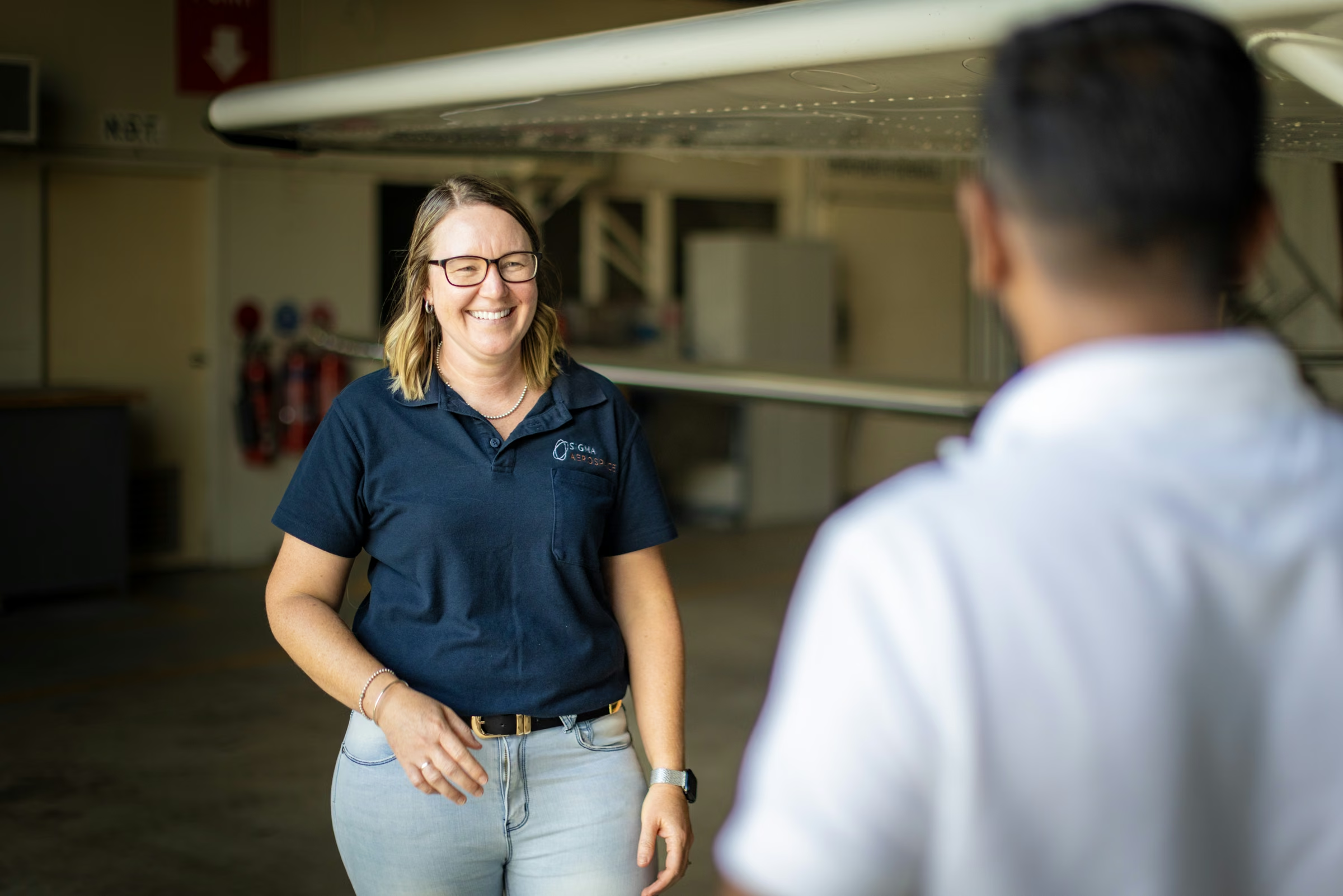
Sigma trainer discussing workplace training with an aircraft maintenance colleague

Support with a rhythm

Know your trainer.
Know your next step.

Questions get answered while you are learning. Your supervisor gets a clearer view of progress, and you get help before a small gap becomes a large one.

Fortnightly

Live technical sessions to work through concepts and questions.

Monthly

One-to-one progress reviews to agree on the next priorities.

On the floor

Planned workplace visits, practical assessment and support for your supervisor.

Between sessions

Trainer contact, structured resources and help when you get stuck.

Your Training Plan sets the learning, assessment and visit arrangements. Check your employer guide for inclusions and visit frequency.

Fixed wing. Rotary. Mechanical. Avionics.

A pathway that fits
your licence stream.

Every plan reflects the aircraft, tasks and role the operator needs. We retain all mandatory qualification and licensing requirements, recognise valid prior study and identify any extra units needed for the agreed outcome. Aircraft type training is a separate course.

B1.1 · Fixed-wing turbine
B1.2 · Fixed-wing piston
B1.3 · Rotary turbine
B1.4 · Rotary piston

B2 · Avionics — pathways for electrical, instrument and radio systems.

Three different milestones

The trade. The qualification.
The licence.

An apprenticeship

Employment, supervised experience and a training contract. You develop as a tradesperson through the work, learning and assessment agreed in your plan.

An Aeroskills qualification

A Certificate IV builds the trade foundation. Diploma pathways cover further units for the selected outcome. CASA licence exams are not required for the Certificate IV itself and are not automatically added to a qualification-only program.

A CASA licence

A separate licensing outcome. The relevant knowledge exams, practical experience and other CASA requirements still apply. A qualification or an apprenticeship alone is not a licence.

We set an individual plan and review progress against evidence. Completion depends on competence, task exposure and the applicable training-contract requirements. CASA decides licence issue.

For maintenance employers

Keep them learning.
Keep them close to the work.

Recurring block release means travel, accommodation and time away from your operation. Choose Sigma as the supervising registered training organisation (SRTO) for structured workplace learning, regular contact and support for the apprentice and their supervisor.

Plan apprentice training around your operation

Queensland employers

Workplace training with Career Boost funding for eligible apprentices and trainees. See co-contributions, support inclusions and the full SAS funding conditions.

Regular trainer contact and practical learning

Employers in other states

Fee-for-service training with clear package costs and quarterly support. Use the calculator, check visit arrangements and download the employer guide.

From College learners

Good support is noticed.

Feedback from engineers on Sigma’s RPL and licensing pathways.

The additional support provided in this course was vastly better than I’ve experienced before. The RPL guidance, practice quizzes, clear email communication, and exam instructions all made the process smooth and stress-free.

Ryan · TP Aerospace

I much appreciated being able to ring them whenever I had a question.

Philemon · Mission Aviation Fellowship

Before you begin

The questions worth asking.

Do I need an apprenticeship before I can talk to Sigma?

No. If you are exploring the trade, start with the candidate profile and resume workshop. For a formal apprenticeship, you will need an employer and the relevant training contract. We can explain the training pathway; we do not guarantee employment.

Can I choose Sigma as my RTO?

Discuss it with your employer and Apprentice Connect Australia Provider. The arrangement depends on the qualification, workplace resources and state requirements. If you have started elsewhere, send us your completed units and training record so we can review credit and the remaining work.

Will I still have to study away from the tools?

Yes. Workplace learning still needs protected study time. You will use structured resources, join technical sessions, complete knowledge assessment and practise under supervision. The model removes the need for recurring block release as the default, not the need to learn.

Why are unit assessments and CASA exams separate?

They answer different questions. Unit assessment needs evidence of the knowledge and performance required by the training product. A CASA basic knowledge examination tests the relevant Part 66 syllabus under examination conditions. Sigma assesses the full unit requirements and prepares learners for the applicable exams as a separate step.

What if I am not ready for an assessment or exam?

Tell your trainer early. We review the gap, explain what needs work and agree on the next learning or practice. Progress is based on evidence, not simply on how long you have been enrolled.

Who pays for training?

That depends on the state, funding eligibility, training contract and employer arrangements. Queensland employers can use our funded-training page; other states can use the fee-for-service guide and calculator. We confirm the individual offer before enrolment.

Qantas aircraft parked at airport gates

Start With
What You Can Show.

Your first resume can start here.

You do not need aviation experience to describe reliability, practical interests and a willingness to learn. Our candidate profile helps you turn those into clear examples for an employer.

Build your candidate profile

Already employed, transferring RTO or planning your next apprentice intake? Talk to the College team.

For employers across Australia

Apprentice training.
Choose your state or territory.

For employers: find the training arrangements, delivery and fees for your workplace. Sigma supports apprentices in metropolitan, regional and remote locations.

WA

Western Australia

Workplace training · fee for service

VIC

Victoria

Workplace training · fee for service

SA

South Australia

Workplace training · fee for service

NSW

New South Wales

Workplace training · fee for service

NT

Northern Territory

Workplace training · fee for service

QLD

Queensland

Funded training · check eligibility

TAS

Tasmania

Workplace training · fee for service

ACT

ACT · Canberra

Workplace training · fee for service

Looking for your first role?

Start with the school-leaver guide, prepare your resume and approach employers. Your training pathway comes together once you have a role.

Sigma Aerospace College

Make your next move.

Looking for your first aircraft maintenance role? Build a resume you can use when approaching employers. Already employing apprentices? Send us your training enquiry.